The $10 Trillion Signal: Why Climate Progress Is Real—And Why Capital Still Falls Short

March 4, 2025 | Dessy Vautrin

It is easy to conclude that global climate action is faltering. Banks are softening net-zero commitments, political cycles are turning hostile, and the United States—under a second Trump presidency—is once again stepping away from multilateral climate leadership. From the outside, the narrative looks bleak. 

Yet the data tells a more complex story. 

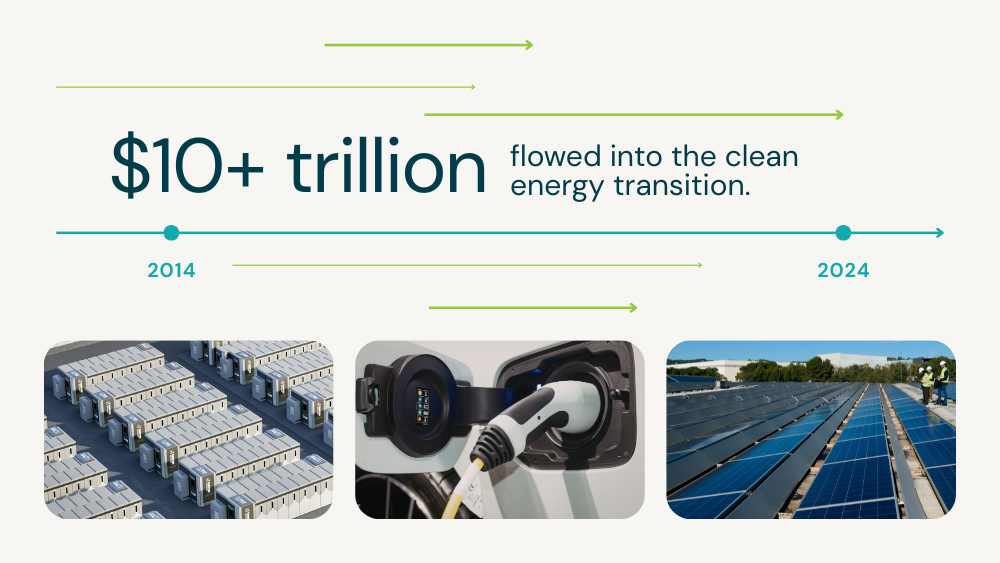
Between 2014 and 2024, more than $10 trillion flowed into the clean energy transition, according to BloombergNEF, with a record $2 trillion invested in 2024 alone across renewables, grids, battery storage, clean transport, and industrial decarbonisation. That is not the profile of a stalled transition. It is the footprint of a structural shift—uneven, underpowered, but undeniably underway. 

The question is no longer whether the transition is happening. It is whether it is happening fast enough, and in the right places. 

From Diplomacy to Deployment

The Paris Agreement marked a turning point not because it solved climate change, but because it reset expectations. For the first time, nearly 200 countries sent a coordinated signal that emissions must fall and energy systems must change. That signal mattered less for diplomats than for markets. 

As Laurence Tubiana, one of the architects of Paris, has noted, the agreement helped establish a shared assumption: that the transition was inevitable. Capital responded accordingly. 

A decade later, the limits of grand climate diplomacy are clearer. COPs cannot build grids, deploy solar farms, or finance resilient infrastructure. What they can do—at their best—is de-risk direction, providing enough policy coherence for capital to move. 

That is precisely what the data now reflects. Global emissions are no longer accelerating unchecked. The UN projects a 10% decline from 2019 levels by 2035, and worst-case warming scenarios have retreated. The world is still on track for roughly 2.8°C of warming by 2100—far above Paris ambitions, but materially better than the 4°C outcomes once considered plausible. 

Progress, in other words, is real—but partial. 

The Capital Gap Beneath the Progress

The $10 trillion headline figure masks a deeper structural problem: investment remains radically misaligned with need. 

Annual clean energy investment is now around $2 trillion. To align with net-zero pathways, that number needs to exceed $5 trillion per year this decade. The gap is not marginal; it is systemic. 

And it is geographically concentrated. 

Advanced economies have captured a disproportionate share of climate capital, while emerging markets—where future energy demand, urbanisation, and emissions growth will be concentrated—remain underfunded. This is not due to a lack of opportunity. It is due to cost of capital, currency risk, regulatory uncertainty, and insufficient risk-sharing mechanisms. 

The result is a paradox: the regions that matter most for global climate outcomes receive the least financing on acceptable terms. 

The Emerging-Markets Supercycle Meets Climate Reality

This is where climate finance intersects with a broader macro dynamic: the emerging-markets supercycle. 

Emerging economies are entering a period of sustained infrastructure build-out driven by demographics, urban growth, industrial expansion, and electrification. Energy systems, transport networks, digital infrastructure, and water resilience must all scale simultaneously. 

This is not a cyclical rebound. It is a structural investment phase. 

Clean energy is central to this cycle—not as an add-on, but as the most cost-effective way to meet rising demand. In many emerging markets, renewables are already the cheapest source of new power. What is missing is not technology, but capital structured for risk, duration, and local conditions. 

Without a rapid increase in climate-aligned investment in emerging markets, global emissions trajectories will not bend fast enough—regardless of progress elsewhere. 

Why Politics Matters Less Than Capital Allocation

The return of climate-skeptic politics in parts of the world, including the US, undoubtedly slows momentum. But it does not reverse the underlying economics. 

Energy transitions are now being driven less by ideology and more by cost curves, energy security, and system resilience. Grids must expand. Storage must scale. Clean power must replace volatile fossil imports. These are not political preferences; they are balance-sheet realities. 

What politics can still influence—critically—is where capital flows and at what price. 

If public finance, multilateral institutions, and development banks fail to crowd in private capital through guarantees, blended structures, and currency solutions, the funding gap will persist—even as headline investment numbers rise. 

From Trillions Spent to Trillions That Matter

The past decade proves that climate diplomacy can shift expectations and unlock capital. The next decade will test whether capital can be deployed with precision. 

The challenge is no longer awareness. It is execution. 

Closing the climate funding gap—particularly in emerging markets—is the difference between a transition that is statistically visible and one that is systemically sufficient. The $10 trillion already invested shows what is possible. The trillions still missing will determine whether progress becomes transformation. 

In that sense, climate success will not be decided in conference halls alone, but in how effectively global capital is mobilised, structured, and deployed where it matters most. 

Directing Capital Where It Matters Most

The climate funding gap is not a shortage of capital, but a failure of allocation. Emerging markets—where most future energy demand will grow—remain underfunded due to structural risks that prevent institutional investors from deploying capital at scale. 

Blue Orb addresses this gap by originating and structuring infrastructure opportunities to institutional standards, transforming viable projects into investable assets aligned with global capital requirements. 

By reducing barriers and enabling scalable investment pathways, Blue Orb helps redirect capital toward the regions where it is most needed—turning capital availability into capital deployment, and progress into systemic transformation. 

Want to learn more about Blue Orb?

Dessy Vautrin

Chief Marketing Officer with 20+ years investor relations, sales and marketing leadership, in local, regional and global roles (North America, Latam, Asia, Africa, Europe).

Stay connected with Blue Orb

Subscribe to our newsletter to receive the latest insights, project updates, and opportunities in solar and energy storage across emerging markets.