
China’s Climate Pledge at the UN: A Milestone—But Still Short of What’s Needed

October 17, 2025 | Tomasz Wnuk

At the 2025 UN Climate Summit in New York, China made the biggest announcement of the week—and perhaps the year.
President Xi Jinping unveiled the country’s long-awaited absolute emissions reduction target, marking a major shift in global climate dynamics.
 
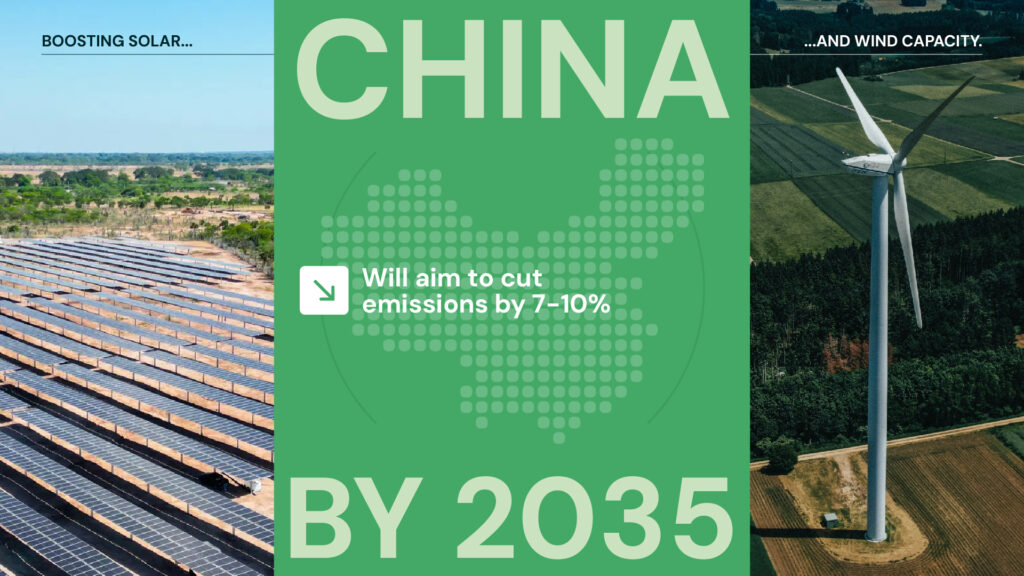
Beijing will aim to cut emissions by 7–10% from peak levels by 2035, while boosting wind and solar capacity sixfold compared to 2020 and raising non-fossil fuels to over 30% of total energy consumption.
For the first time, China has committed to a numerical reduction rather than just an emissions “intensity” target. Yet, as FT’s climate team points out, the move—while historic—is still far from aligning with the 1.5°C pathway agreed in Paris.

China’s Commitment: Historic Yet Conservative

What Beijing Promised
  1. Emissions Target:
    7–10% reduction from peak by 2035.
  2. Energy Mix:
    Non-fossil fuels (solar, wind, nuclear, hydro, etc.) to exceed 30% of total energy consumption.
  3. Renewable Scale-Up:
    Wind and solar capacity to increase sixfold from 2020 levels.
These pledges mark a symbolic turning point — China is no longer promising to slow growth in emissions, but to actually reverse it.
 
Why It Matters
  1. China accounts for about one-third of global CO₂ emissions.
  2. Its policy trajectory is therefore the single largest determinant of whether the world can meet the 1.5°C Paris goal.
  3. An absolute reduction commitment signals that Beijing is ready to anchor itself in the global accountability framework—at least in principle.
The Catch
Climate experts had hoped for a 15% or greater reduction, given China’s record-breaking renewable rollout and maturing clean-tech industry.
The 7–10% target is ambitious in optics, modest in substance—designed to be achievable rather than transformational.

Reading the Data: Emissions, Coal and the Plateau

Using datasets from the Global Carbon Budget and EmberFT’s Nassos Stylianou visualized the numbers behind the announcement.
 
Key Insights
  1. China’s emissions history:
    1. Now produces ~30% of global annual emissions.
    2. Historical responsibility sits at ~15%—reflecting its late but steep industrialization curve.
  2. Coal dependency:
    Coal remains China’s biggest obstacle. Despite the renewable surge, coal consumption has risen nearly every year since 2000.
  3. Signs of a plateau:
    Ember data shows that coal and gas use have flattened in the power sector over the past year.
    Combined with slowing manufacturing growth, this may signal a fossil-fuel plateau—a critical first step toward peaking.
Why This Matters
If the plateau holds, China could overdeliver on its target, repeating a familiar strategy: set cautious goals, then exceed them to reinforce credibility. However, that depends on how fast renewables can continue displacing coal—not just adding capacity in parallel.

The Broader Context: Competing Narratives

“Green tech is the trend of our time” — Xi Jinping
“A joke” — Donald Trump
 
The FT coverage contrasts these two visions starkly.
While China leans into clean tech as an engine of industrial dominance, the U.S. (under Trump’s renewed administration) has pressured the World Bank to loosen restrictions on fossil fuel projects—part of a broader fossil expansion agenda.
Economist Gillian Tett noted that Trump is unlikely to win this “geoeconomic energy fight” against China in the long run.
However, she warned of short-term disruption as political and trade tensions collide with the climate agenda.
 

This divide underscores a new geopolitical reality:

  1. Energy transition has become industrial policy.
  2. Cleantech is strategy, not charity.

Skeptical Notes: The Gaps Between Optics and Outcomes

While China’s announcement is welcome, several critical caveats remain:
  1. Relative vs. Absolute Ambition
    A 7–10% reduction by 2035 from peak levels still allows substantial emissions through the 2030s—potentially blowing through the 1.5°C carbon budget.
  2. Coal Lock-In
    New coal plants continue to be approved for “energy security” reasons. Unless early retirement accelerates, total emissions could stagnate rather than decline.
  3. Transparency & Data
    China’s national reporting lags in public transparency. Without verifiable emissions data, global trust in targets remains partial.
  4. Dependence on Manufacturing Cycles
    A large portion of emissions gains stem from slower industrial growth. If the economy reaccelerates, emissions could rebound.
  5. Global Spillovers
    As China decarbonizes, it may export coal, steel, and cement output to other developing countries, shifting emissions rather than eliminating them.

In Conclusion

China’s UN announcement marks a historic inflection point: the world’s top emitter has entered the era of absolute climate commitments.
But it’s also a reminder that symbolic progress can mask lingering inertia.
The real test isn’t whether Beijing meets its new 7–10% reduction target—it’s whether this decade locks in the systems that make far deeper cuts inevitable.

Until then, the climate race remains what it has always been: a battle between what’s politically feasible and what’s physically necessary.

Want to learn more about Blue Orb?

Tomas Wnuk

As a Market Researcher, he is fueled by data and curiosity, uncoversing actionable insights, identifiyng opportunities, and crafting strategies that make an impact.

Financial Times. (2025, October 17 ). Biggest news of UN climate summit. The Climate Graphic: Explained. [Newsletter]