Bridging the Infrastructure Divide 

What $106 Trillion of Global Investment Means for Climate Finance and Emerging Markets 

February 27, 2025 | Dessy Vautrin

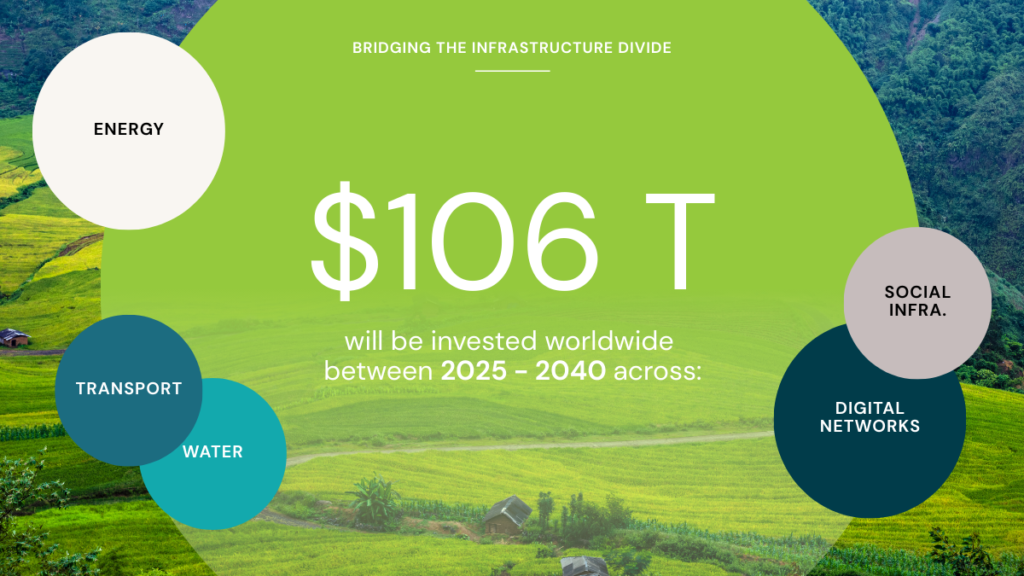
Global infrastructure investment is entering a decisive phase. According to recent estimates, approximately $106 trillion will be invested worldwide between 2025 and 2040 across transport, energy, digital networks, water, and social infrastructure. This wave of capital deployment is not incremental—it reflects a structural shift in how and where economic growth will be built over the next two decades. 

Yet beneath the headline number lies a critical tension: while capital needs are immense, financing remains unevenly distributed, particularly across emerging markets, where infrastructure demand, climate exposure, and growth dynamics converge most sharply.

A Regional Reallocation of Capital

The regional breakdown of projected infrastructure investment reveals a profound rebalancing. Asia alone is expected to account for roughly two-thirds of global spending, close to $70 trillion through 2040. The Americas and Europe follow at a significant distance, while Africa and Oceania together capture less than 10% of total projected investment. 

This distribution mirrors long-term macro trends: faster population growth, urbanisation, industrial expansion, and digital adoption in emerging economies, contrasted with more mature, replacement-driven infrastructure cycles in advanced markets. In effect, infrastructure investment is tracking the center of gravity of future economic growth. 

This is a defining feature of what many observers describe as an emerging-markets supercycle—a multi-decade phase characterised by sustained capital formation, rising consumption, and expanding productive capacity across the Global South. Infrastructure sits at the core of this cycle, acting as both a prerequisite for growth and a magnet for long-duration capital. 

Blue Orb — Capital Flow World Map

Energy and Transport: The Backbone of the Transition

By sector, transport infrastructure remains the single largest investment category, reflecting continued demand for roads, rail, ports, and logistics networks. However, the energy sector—representing more than $20 trillion of planned investment—may be the most strategically significant. 

This is not merely about expanding generation capacity. It reflects a deeper transformation of energy systems: grid modernisation, renewable deployment, storage, electrification, and digital energy management. These investments are essential to meet rising demand while reducing emissions and increasing system resilience. 

Despite the scale of planned spending, current trajectories remain misaligned with climate objectives. Energy infrastructure investment still falls well short of what is required for a net-zero-aligned pathway, particularly in emerging markets, where capital costs are higher and risk perceptions more acute. 

The Infrastructure Funding Gap

The $106 trillion headline figure masks a more sobering reality: global infrastructure investment is still insufficient relative to needs. Estimates suggest a cumulative shortfall running into the tens of trillions of dollars by 2040, with gaps concentrated in energy, water, transport, and climate-resilient systems. 

Nowhere is this gap more pronounced than in emerging economies. These markets face a dual challenge: building new infrastructure to support growth, while simultaneously upgrading systems to withstand climate stress. Adaptation needs alone amount to hundreds of billions of dollars annually, yet current funding levels cover only a fraction of that requirement. 

This imbalance highlights a structural issue in global finance. Public balance sheets—especially in developing countries—cannot absorb the full burden of infrastructure build-out. At the same time, private capital has historically remained under-allocated to infrastructure in emerging markets, deterred by perceived risk, regulatory uncertainty, and currency exposure. 

Where the Supercycle Meets the Climate Imperative

Emerging markets sit at the intersection of two powerful forces: accelerating economic growth and escalating climate vulnerability. Energy demand growth is fastest in these regions, urban populations are expanding rapidly, and infrastructure deficits remain material. At the same time, many emerging economies possess abundant renewable resources, positioning them as critical nodes in the global energy transition. 

This convergence is what gives the emerging-markets supercycle its strategic significance. Infrastructure investment in these regions is not simply a development necessity—it is a prerequisite for global decarbonisation. Without a rapid scaling of clean energy, grids, and resilient systems in emerging markets, global climate targets remain out of reach. 

Yet achieving this scale requires new financing models, not just more capital. Blended finance, guarantees, risk-sharing mechanisms, and stronger policy frameworks are essential to crowd institutional capital into markets where the need—and potential impact—is greatest. 

Implications for Capital Allocation

For investors, the message is clear. The next decade of infrastructure investment will be defined not only by volume, but by where and how capital is deployed. Emerging markets represent the largest share of future infrastructure demand, the fastest growth rates, and some of the most compelling long-term opportunities—provided risks are appropriately structured and mitigated. 

For policymakers, the priority lies in creating stable, investable environments that align infrastructure planning with climate resilience and energy transition goals. Clear regulation, credible transition pathways, and effective public-private collaboration will determine whether projected investment translates into durable, inclusive growth. 

As global capital mobilises toward infrastructure at unprecedented scale, the convergence of climate finance, infrastructure gaps, and emerging-market growth defines a generational investment challenge—and opportunity. Bridging this divide is no longer optional; it is central to economic stability, climate outcomes, and long-term value creation. 

How Blue Orb Bridges the Divide

Blue Orb was established to close the gap between global capital and infrastructure deployment in emerging markets. Our model focuses on originating, structuring, and de-risking renewable energy and infrastructure projects, transforming early-stage opportunities into institutionally investable assets. 

By securing land, permits, grid access, and strong local partnerships, and by mitigating key risks such as regulatory uncertainty and execution complexity, we make projects accessible to long-term investors. This enables institutional capital to deploy at scale in markets where infrastructure demand, climate exposure, and growth potential are highest. 

In doing so, Blue Orb helps ensure that capital flows not only where risk is lowest, but where impact, demand, and long-term value creation are greatest. 

Want to learn more about Blue Orb?

Dessy Vautrin

Chief Marketing Officer with 20+ years investor relations, sales and marketing leadership, in local, regional and global roles (North America, Latam, Asia, Africa, Europe).

Stay connected with Blue Orb

Subscribe to our newsletter to receive the latest insights, project updates, and opportunities in solar and energy storage across emerging markets.