The True Geography of the Solar Buildout —
And Why It Matters Beyond Panels 

March 12, 2025 | Matt Dabrowski

Solar power has become shorthand for the energy transition. But a global solar capacity map reveals something deeper: the energy transition isn’t just about clean technology — it’s about where industrial power is being concentrated and where real leverage lies.  

Here’s what a detailed breakdown of planned and existing solar capacity shows — and why it should recalibrate how we think about renewable energy strategy. 

A Concentrated Buildout, Not a Distributed Transition

Global solar capacity — including operational and planned projects — is forecast to approach 2.9 terawatts (TW) in the coming years. But less than 15 countries account for more than 80 % of that pipeline.  

This concentration matters because: 

  • It shows where industrial capabilities, capital flows, and grid readiness are actually aligning. 
  • It exposes a structural tension between climate targets and capacity deployment realities. 

China’s Dominance Is Strategic — Not Just Statistical

China alone accounts for roughly one-third of the entire world’s planned solar capacity, far more than the next five countries combined.  

Why that matters: 

  • China controls not only installations, but upstream supply chains — over 80 % of global solar panel materials and components. This vertical integration gives it a material advantage beyond the power sector itself.  
  • The scale of China’s pipeline sets the global price curve and deployment rhythm, shaping capital allocation decisions in competing markets — the same way China’s manufacturing scale influences EV battery and EV export economics. 

This isn’t just about renewables. It’s about who “owns” the industrial cycle of metals, modules, and modules’ jobs. That level of integration changes competitive dynamics — economically and geopolitically. 

The U.S. and India: Growing but Still Catching Up

The United States and India each have hundreds of gigawatts of combined operational + planned capacity — strong numbers that reflect major policy pushes (e.g., the U.S. Inflation Reduction Act and India’s national solar targets).  

But even together, their cumulative solar capacity doesn’t match China’s pipeline, highlighting: 

  • The limits of policy stimulus without matching industrial base scale. 
  • How differences in financing, supply chains, permitting, and grid readiness matter as much as headline targets. 

Emerging Market Nodes Are Turning Heads

Beyond the usual suspects, new players are emerging. 

Countries such as Mauritania and Colombia have recently entered the top ranks of future solar capacity, each with tens of gigawatts planned.  

These aren’t just novelties: 

  • They signal that climate-aligned capital markets are beginning to look beyond traditional North/South divides. 
  • They reveal how global solar economics are shifting — with lower balances of system costs and improved financing enabling projects outside the largest economies. 

Yet these markets will only reach potential if capital flows, grid stability, and policy frameworks scale jointly — not just individually. 

A Lens on Transition, Not Just a Map

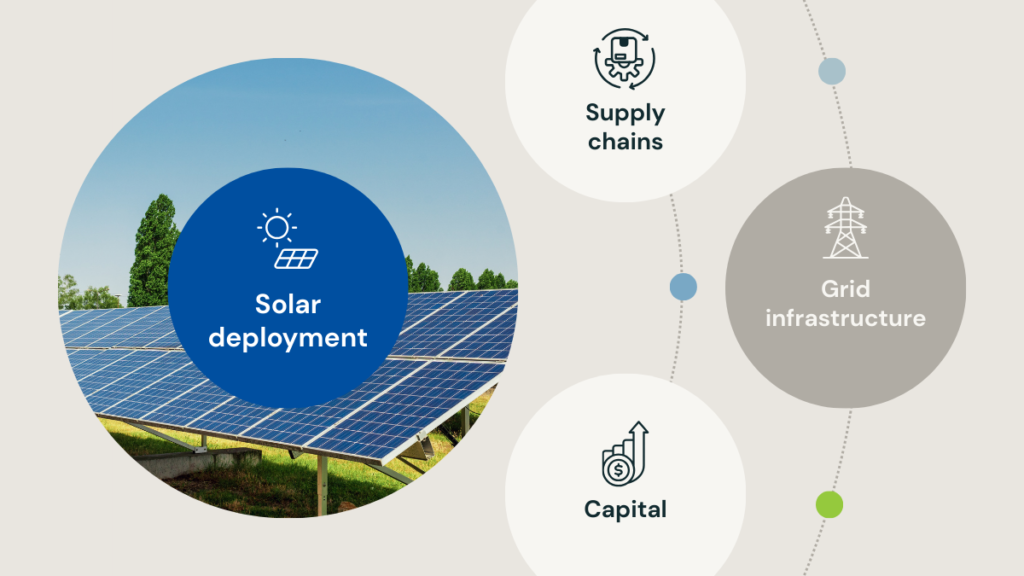
Raw MW figures are helpful, but they miss something deeper: the capacity pipeline is a structural signal about where solar will actually shape industrial and economic power. It’s not enough to build panels — a country needs supply chains, capital, grid infrastructure, and skilled labor to convert capacity into resilient decarbonised economies. 

In other words, the global solar map is not just a chart of panels. It is a map of where value and leverage in the energy transition are consolidating. 

This matters for investors, policymakers, and planners precisely because: 

  1. Solar deployment without integrated supply chains often stalls at grid bottlenecks. 
  2. Capital follows policy certainty — not just climate rhetoric. 
  3. Markets that combine installation capacity with manufacturing scale will capture more of the economic upside of the energy transition. 

If the solar transition means anything at scale, it is not simply reducing emissions. It is about who anchors energy and industrial competitiveness in the coming decades. 

Global Solar Capacity
2,852 GW Total Global Pipeline
925 GW Operational Capacity
1,927 GW Prospective Pipeline
# Country Operational (MWac) Prospective Total Capacity

Enabling the Next Solar Markets

Many of the countries now entering the global solar pipeline have world-class natural resources but lack the project structures, risk alignment, and institutional readiness required to attract large-scale capital. Resource availability alone does not translate into deployable infrastructure. 

Blue Orb addresses this gap by originating, structuring, and de-risking solar projects in emerging markets before institutional capital enters. This includes securing sites, coordinating permitting and grid integration, and structuring projects to meet the technical and financial requirements of long-term investors. 

By resolving early-stage barriers and aligning local stakeholders with global capital, Blue Orb enables high-potential solar markets to move from theoretical capacity to bankable, investable infrastructure — accelerating their integration into the global energy transition. 

Want to learn more about Blue Orb?

Matt Dabrowski

Economic Analyst and Researcher with 15+ years in macroeconomic research, data-driven analysis, and institutional advisory.

Stay connected with Blue Orb

Subscribe to our newsletter to receive the latest insights, project updates, and opportunities in solar and energy storage across emerging markets.