The Environmental Age Is Already Here,
Davos 2026 Marked the Turning Point 

February 13, 2025 | Dessy Vautrin

This year’s World Economic Forum meeting in Davos made one thing unmistakably clear: environmental sustainability has entered a new phase. 

We are no longer approaching the Environmental Age — we are already in it. 

After the Industrial Age and the Information Age, the defining task of our time is no longer building new systems at any cost, but cleaning up, redesigning, and transitioning the systems we have built — energy, materials, industry, and infrastructure — so they are resilient, circular, and compatible with long-term human and planetary wellbeing. 

What made Davos different this year was not what dominated the headlines. Away from the divisive geopolitical narratives amplified by mainstream media, the impact investment and sustainability community showed clear signs of coming of age. 

The shift was visible and consistent: 

  • Less call to action → more action 
  • Less conversation → more pragmatism 
  • Less greenwashing → more real impact 
  • Less strategy → more implementation 
  • Less frameworks → more investments 
  • Less misalignment → more collaboration 
  • Less commiseration → more positive narratives 
  • Less waste → more value creation 

This was not incremental progress. It was a change in posture. 

In a complex global environment marked by geopolitical fragmentation, energy insecurity, and economic pressure, performative sustainability is no longer viable. Real impact leaders are stepping forward — and those who were never true believers are quietly stepping aside. 

Circular Economy: From Vision to Execution

This maturity is particularly evident in circular economy solutions for the materials and industrial transition, where momentum is now tangible. 

Across Davos, multiple events were dedicated to Circular Economy and Blue Economy pathways. The focus was no longer on defining the problem, but on how to implement solutions at scale. 

Progress is measurable: 

  • The Ellen MacArthur Foundation continues to drive research, partnerships, and competitiveness, pushing circularity from vision into real-world deployment 
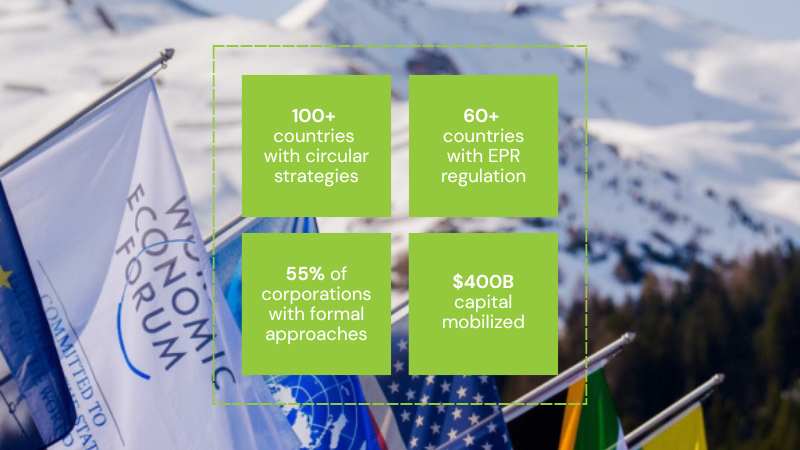
  • Over 100 countries now have national circular economy strategies 
  • More than 60 countries have implemented Extended Producer Responsibility (EPR) regulation 
  • Around 55% of corporations have formal circular economy approaches 
  • Approximately $400 billion of capital has been mobilized, primarily by governments and corporates 
  • Partnerships and initiatives are accelerating implementation across Europe, the Americas, the Middle East, and Asia 
  • The energy transition is actively enabling more circular solutions across plastics, batteries, food systems, apparel, rare earths, and other critical industrial value chains 
  • Leading early-growth investors are developing new models to partner with and scale circular solutions globally 

This is real momentum. And it matters. 

The Gap That Still Defines the Transition

Yet despite this progress, one structural issue remains unresolved. 

The capital mobilized so far is clearly insufficient — and not always flowing to where it matters most. 

Very few funds, including specialist vehicles such as Una Terra Early Growth Fund, operate with a deep, systems-level understanding of the materials and industrial transition. Even fewer are positioned to deploy capital where future demand — and future impact — will be greatest. 

Emerging markets will drive the majority of: 

  • Future energy demand 
  • Infrastructure development 
  • Materials consumption 
  • Industrial growth 

They will ultimately determine the success or failure of the global energy and circular economy transition. 

And yet, they receive only around 15% of global energy investment. 

This is not simply an impact gap. It is a capital allocation mismatch. 

Why Alignment Matters More Than Momentum

The Environmental Age will not be defined by how many strategies are written or how many panels are convened. It will be defined by whether capital aligns with real demand. 

Momentum is clearly building — but alignment is still lagging. 

Aligning capital with demand, particularly in emerging markets, is the real unlock: 

  • for accelerating the energy and materials transition 
  • for delivering measurable, system-level impact 
  • and for generating resilient, long-term returns 

Moving Farther and Faster — Together

The next phase requires moving farther and faster — and bringing others with us. 

Governments, corporates, NGOs, investors, entrepreneurs, and individuals all have a role to play. But roles must be aligned with reality, not rhetoric. 

The Environmental Age demands execution, collaboration, and capital that is willing to engage with complexity — not avoid it. 

That is where the transition will be won. 

Want to learn more about Blue Orb?

Dessy Vautrin

Chief Marketing Officer with 20+ years investor relations, sales and marketing leadership, in local, regional and global roles (North America, Latam, Asia, Africa, Europe).