
When the Future of Clean Energy Depends on the Emerging World
January 27, 2026 | Dessy Vautrin
How solar, wind and electrification in developing economies are becoming central to global decarbonization — if the money and institutions fall into place.
As the world races to cut greenhouse gas emissions, a new truth is becoming unavoidable: the future of clean energy will not be decided in Washington, Brussels or Tokyo, but in Nairobi, Mumbai, Rio de Janeiro and Jakarta.
According to Reuters, emerging and developing economies are already leading some dimensions of the global energy transition — particularly in solar deployment, renewable manufacturing, and distributed electrification. Yet they face structural barriers in finance, governance, and project readiness that could slow the very transformation they are meant to drive.
This post unpacks the data, challenges, and implications highlighted by Reuters and other international energy reports, exploring what it will take for the Global South to become not just a participant in, but the engine of, the world’s clean-energy revolution.
The Shift Is Underway — Even If It’s Not Always Visible
More than 60% of emerging and developing economies are now outpacing the U.S. and Europe in the share of new power generation that comes from clean sources, Reuters notes.
- What does that mean in practice?
- In emerging and developing economies (excluding China), 87% of power-generation investment in 2024 went into clean energy.
- Global demand for fossil fuels is flattening, with Reuters citing 2025 data showing declines in coal and oil demand in several major Asian markets.
- Three reinforcing forces are driving this shift: physics, economics, and sovereignty.
1. Physics and efficiency:
Solar panels, electric motors, and heat pumps convert far more of their input energy into useful output than combustion-based systems. They waste less and perform better.
Solar panels, electric motors, and heat pumps convert far more of their input energy into useful output than combustion-based systems. They waste less and perform better.
2. Economics and scalability:
Electro-technologies behave like manufactured goods: their costs fall rapidly as production scales. Industry data suggests roughly a 20% cost decline with each doubling of deployment.
Electro-technologies behave like manufactured goods: their costs fall rapidly as production scales. Industry data suggests roughly a 20% cost decline with each doubling of deployment.
3. Geopolitics and sovereignty:
Reliance on imported oil and gas has long tied developing countries to volatile global markets. Renewables, by contrast, can be produced locally, allowing nations to reduce exposure to fuel price swings and capture more domestic value.
Reliance on imported oil and gas has long tied developing countries to volatile global markets. Renewables, by contrast, can be produced locally, allowing nations to reduce exposure to fuel price swings and capture more domestic value.
According to Reuters, developing nations hold about 70% of global solar and wind resource potential and 50% of the minerals essential for the energy transition. As a result, they could account for over 60% of the increase in global clean-energy capacity over the next decade.
This shift has led some analysts to speak of a new “industrial sunbelt” — a belt of equatorial and subtropical economies that could anchor manufacturing, critical-minerals processing, and renewable-powered industry.
But if the potential is this great, Reuters asks, why isn’t the clean transition already dominated by these economies?
The Bottlenecks: Why Promise Isn’t Enough
The article identifies four structural barriers that could slow or derail progress across the emerging world.
1. Finance: The Missing Ingredient
Despite possessing the world’s richest solar and wind resources, Africa has received less than 2% of global clean-energy investment over the past five years. To meet global climate targets, annual clean-energy investment in emerging markets (excluding China) would need to increase sixfold by 2030, reaching roughly US $1.6 trillion per year.
Private capital remains hesitant, citing currency volatility, political risk, and limited project pipelines. Development banks provide support but cannot fill the gap alone.
2. Institutional Capacity and Project Readiness
Even when money is available, too few projects are “bankable.”
Weak regulatory frameworks, inconsistent permitting, and limited technical capacity mean many projects stall before financing. Reuters emphasizes the importance of standardized best-practice templates for national energy planning and transparent procurement to attract investment at scale.
Weak regulatory frameworks, inconsistent permitting, and limited technical capacity mean many projects stall before financing. Reuters emphasizes the importance of standardized best-practice templates for national energy planning and transparent procurement to attract investment at scale.
3. Bridging Public and Private Ambitions
Country-level “platforms” that coordinate between governments, development banks, and private investors are emerging as a key tool.
At the 2024 G20 Summit, the U.K. and Brazil launched the Global Clean Power Alliance Finance Mission, aimed at helping countries structure and present credible investment plans that can unlock private finance.
4. Climate Resilience and Adaptation
The infrastructure needed for clean energy—solar farms, transmission lines, coastal wind hubs—is increasingly exposed to extreme weather.
Studies cited by Reuters show that investments in resilience—such as flood-proofing, cooling systems, or diversified grids—can reduce climate-related losses by up to twenty-fold. Yet resilience spending still accounts for a small fraction of total energy budgets.
The takeaway is stark: the challenge is not merely deploying technology, but deploying it well—sustainably, credibly, and inclusively.
What Must Happen for the Vision to Succeed
Natural systems change through phase shifts, not fine-tuning. Species extinction rates are 100–1,000× above natural baselines, signalling breached thresholds. Economic systems behave similarly. The transition feels nonlinear because it is.
|
What Needs to Happen
|
Action & Caveats
|
|---|---|
|
Massive scaling of investment:
|
Private capital must provide most funding; development banks should focus on de-risking and concessional finance, but risk perceptions remain high.
|
|
Define clear planning templates:
|
Standardized, locally adaptable energy-planning models can reduce uncertainty and improve investor confidence.
|
|
Build institutional capacity:
|
Strengthening governance, procurement systems, and project management is essential to turn policy into projects.
|
|
Move from plans to pipeline:
|
National energy strategies must yield tangible, bankable projects rather than aspirational targets.
|
|
Embed climate resilience:
|
Each project should be designed for extreme-weather risks and adaptive management.
|
|
Foster cooperation and coordination:
|
Country platforms, financial institutions, and private investors must align around coherent national strategies.
|
Reuters stresses that inclusion—social as well as financial—will be decisive.
Without mechanisms ensuring that local communities benefit, even technically sound projects can face opposition or fail to deliver shared prosperity.
Skeptical Notes and Key Risks
Analysts and climate-finance experts, including those cited by Blue Orb, outline several risks that could undermine momentum:
- Overestimating readiness: Resource potential does not equal deliverable capacity; grid constraints and interconnection delays remain severe.
- Currency and sovereign risk: Investors remain wary of exchange-rate volatility and debt sustainability in low-income nations.
- Concentration of benefits: If manufacturing and intellectual property remain in advanced economies, developing countries may capture little of the value chain.
- Resilience gaps: The projected twenty-fold return on resilience investments depends entirely on implementation quality and long-term maintenance.
- Dependence on external capital and technology: Hosting projects is not the same as owning them; many countries still rely on imported expertise and finance.
In short, the vision is compelling—but execution will determine whether it becomes reality. Without strong institutions, transparent governance, and local ownership, clean energy risks reproducing the same asymmetries that fossil fuels once entrenched.
CONCLUSION
The coming decade will determine whether the clean-energy revolution succeeds or stalls—and much of that outcome now lies in the hands of emerging economies.
As Reuters highlights, these countries already possess the core ingredients: abundant renewable resources, fast-growing energy demand, and the economic motivation to escape fossil dependence.
But potential alone does not drive transformation. Delivering on this promise means bridging the gap between ambition and implementation:
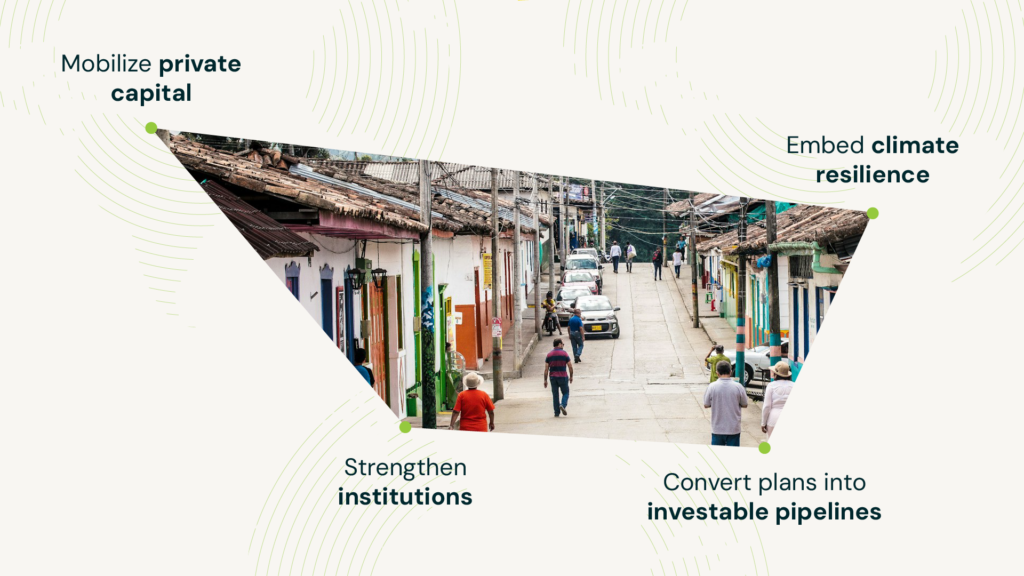
mobilizing private capital, strengthening institutions, converting national plans into investable pipelines, and embedding climate resilience in every decision.
mobilizing private capital, strengthening institutions, converting national plans into investable pipelines, and embedding climate resilience in every decision.
At COP30 and beyond, world leaders, financiers, and development institutions must stop treating the transition as a project for the rich world to fund and the poor world to endure.
The truth is simpler—and more urgent: the fate of the global climate will be decided where the sun shines strongest and the wind blows hardest.
If the Global South succeeds in leading this transition, the entire world wins.
If it falters, no amount of progress in the North will be enough to keep 1.5 °C within reach.
If it falters, no amount of progress in the North will be enough to keep 1.5 °C within reach.

Dessy Vautrin
Chief Marketing Officer with 20+ years investor relations, sales and marketing leadership, in local, regional and global roles (North America, Latam, Asia, Africa, Europe).
